Introduction
There are two types of startups in Nigeria right now. The first has a great product, a professional website, and active social media pages — but nobody seems to remember them, trust them, or choose them over a competitor with inferior offerings. The second has built a brand — and their audience would feel the loss if they disappeared.
The difference is not budget. It is not design. It is brand clarity.
Brand development is the process of creating a clear, consistent, compelling identity that makes your startup immediately recognisable, credible, and desirable to your ideal customer. This guide shows you how to build it from scratch.
What Brand Development Actually Means for a Startup
Most founders think branding is about logos, colour palettes, and fonts. It is not. Those are brand assets — the physical expression of a brand. The brand itself is what people believe about your business when they are not looking at your logo.
Your brand is the sum of every interaction someone has with your business — the words on your website, the tone of your customer service emails, the quality of your content, the consistency of your visual identity, the reliability of your promises.
Brand development is the process of intentionally shaping all of those interactions toward a single, coherent impression.
| “A brand is not what you say it is. It is what your customers say it is when you are not in the room.” |
The 4 Pillars of Startup Brand Development
Pillar 1 — Brand Positioning
Positioning is the foundation. It defines exactly who you serve, what problem you solve, and why your solution is the best choice for that specific person over every alternative. Your positioning statement is the lens through which every brand decision should be made.
Use the Tombri Positioning Formula: For [specific customer] who [has this problem], we provide [specific solution] that delivers [measurable outcome], unlike [competitor approach].
Write this. Print it. Put it at the top of every marketing brief. Every piece of content, every ad, every email should be consistent with this statement.
→ Related: The Complete Guide to Digital Marketing for Startups — full section on ICP and positioning (tombridigital.com/blog/digital-marketing-for-startups-nigeria)
Pillar 2 — Brand Voice and Tone
Your brand voice is how you sound in writing. It is your personality on the page. It must be consistent across every touchpoint — your website, your emails, your social posts, your customer service responses, your pitch deck.
Define your brand voice with three words. Then for each word, write one sentence showing what that word means in practice and one sentence showing what it explicitly does not mean.
For example: Direct — We say exactly what we mean without jargon or padding. Direct does not mean blunt or dismissive.
Pillar 3 — Visual Identity
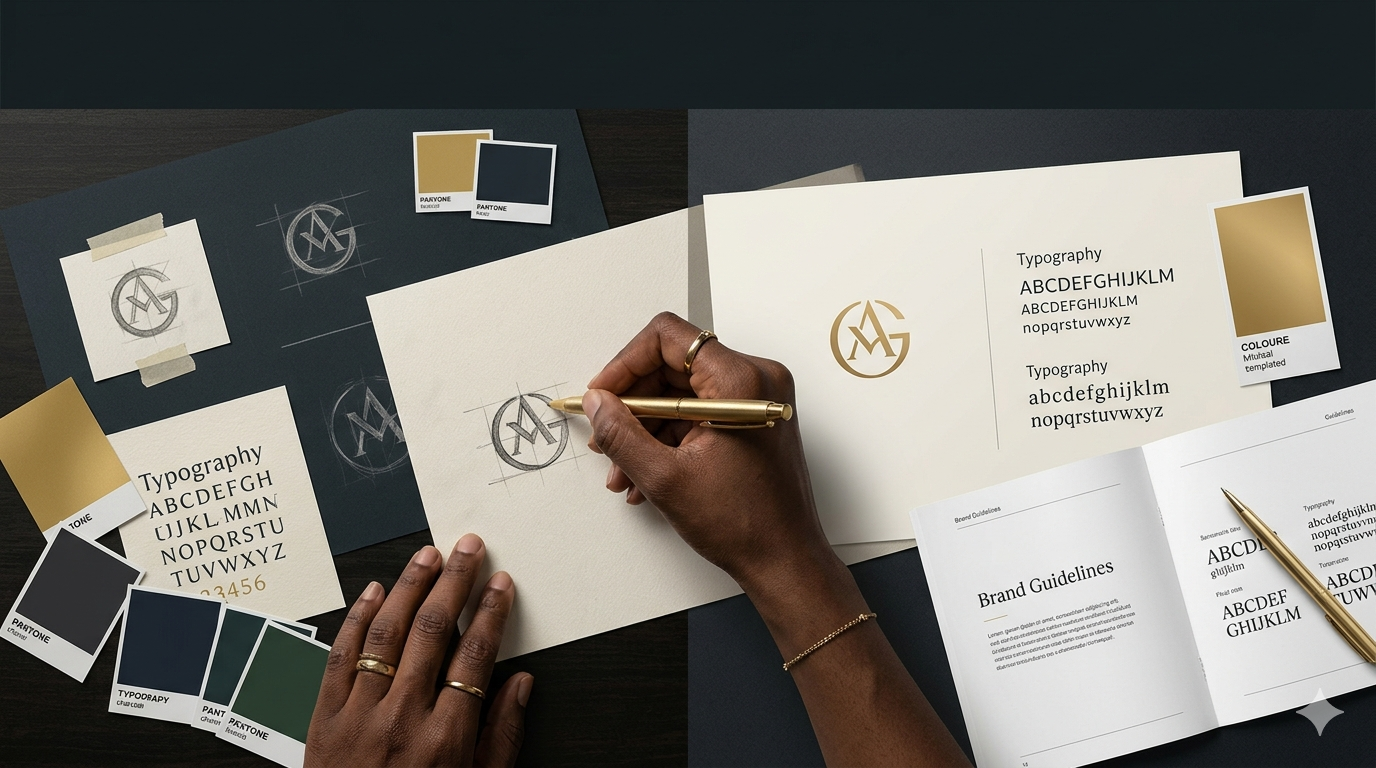
Your visual identity is the consistent look and feel of your brand — logo, colour palette, typography, imagery style, and design templates. It is what makes your brand immediately recognisable across every platform.
For a startup, you do not need a ₦5M rebrand. You need three things: a clean, professional logo (not clip art), a two-colour palette used consistently, and one primary font used across all materials. Consistency beats complexity every time.
The biggest visual identity mistake Nigerian startups make: using different colours, different fonts, and different tones across their website, Instagram, and business cards. This signals disorganisation and destroys trust subconsciously.
Pillar 4 — Brand Experience
Your brand experience is everything your customer feels before, during, and after buying from you. The ease of your booking process, the speed of your responses, the quality of your delivery, the thoughtfulness of your follow-up.
This is where most startups with great positioning and beautiful visual identities lose. They have built an attractive front door but a chaotic interior. Brand experience is what turns a first-time buyer into a loyal advocate who tells everyone about you.
How to Audit Your Current Brand in 30 Minutes
Before building anything new, understand where you are. Run this quick audit:
- Google your business name. What comes up? Does the first page reflect what you want to be known for?
- Visit your own website as if you are a first-time visitor. Can you tell within 10 seconds who you serve and what you do?
- Read your last 10 social media posts. Could a stranger identify your brand voice from them?
- Open your email marketing tool. Does your email design match your website visually?
- Ask your last three customers: ‘How would you describe us to a friend?’ Are their answers consistent with your positioning?
The Brand Development Roadmap for Nigerian Startups
| Week 1 | Positioning | Write your ICP, positioning statement, and UVP. Share with your team. Update your website headline. |
| Week 2 | Voice and Tone | Define 3 brand voice words with examples. Rewrite your About page and email signature in this voice. |
| Week 3 | Visual Identity | Finalise logo (use Canva Pro or hire a local designer). Set your 2-colour palette. Choose your primary font. |
| Week 4 | Brand Guidelines | Document everything above in a single-page brand guide. Share with anyone who creates content for you. |
| Month 2+ | Consistency Audit | Every month, review all brand touchpoints for consistency. Brand equity is built in the repetition. |
Conclusion
Brand development is not a luxury for startups that have ‘made it.’ It is the work that makes making it possible. A clear, consistent, compelling brand reduces your cost per acquisition, increases your close rate, commands higher prices, and creates the kind of loyalty that no ad campaign can buy.Start with positioning. Everything else follows from that one clear foundation.
Leave a Reply