Introduction
97% of the people who visit your website today will not buy. Not because your product is bad. Not because your price is wrong. Because there is no path.
A sales funnel is that path. It is the deliberate sequence of steps that moves a complete stranger from ‘I’ve never heard of this’ to ‘I’m a loyal customer who tells everyone about you.’ Every business that grows predictably has one. Most startups that plateau do not.
This guide walks you through how to build a sales funnel for your startup from scratch — with the exact stages, tools, and conversion benchmarks you need to make it work.
What Is a Sales Funnel and Why Does Your Startup Need One?
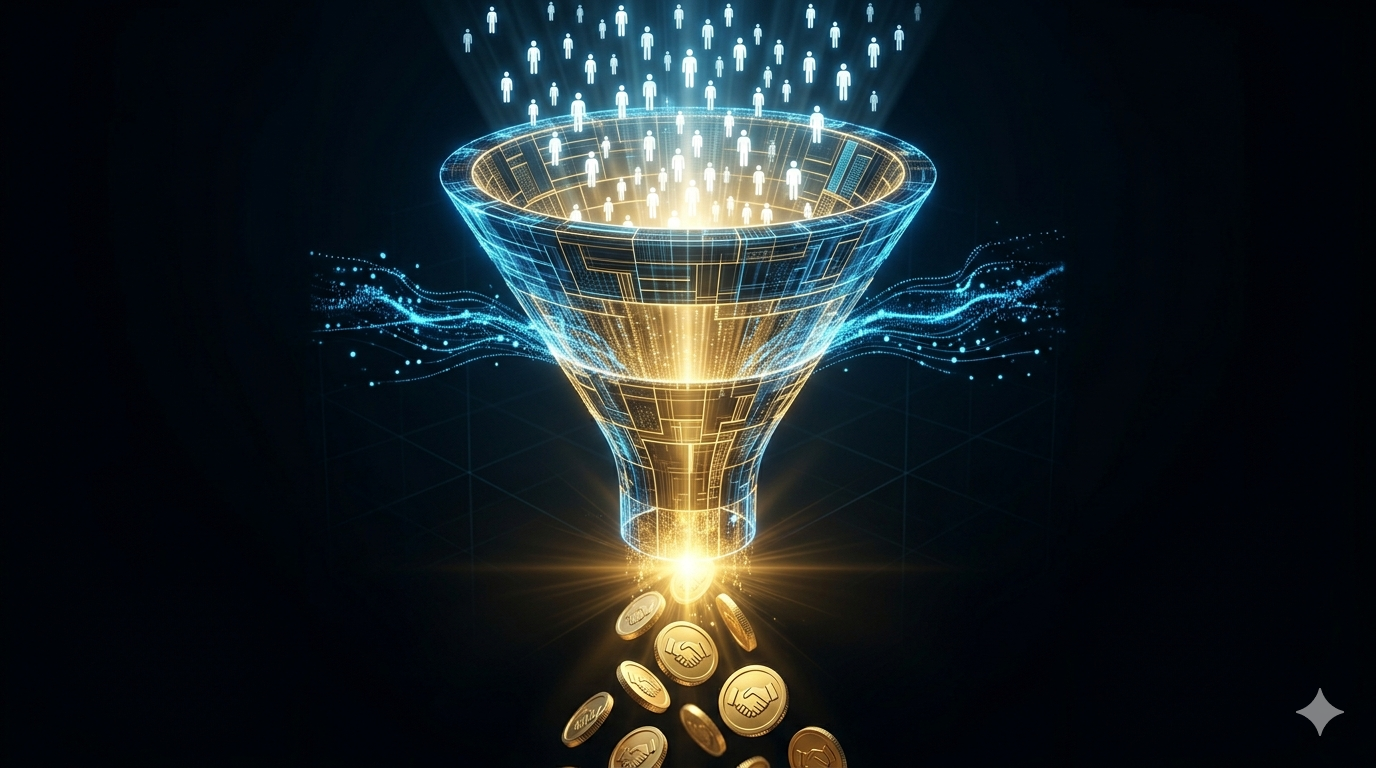
A sales funnel is a marketing model that maps the journey a customer takes from first awareness of your business to final purchase and beyond. The name comes from the shape: wide at the top (many people enter) and narrow at the bottom (fewer people buy — but they are the right ones).
Without a funnel, you are relying on the rare person who visits your website at exactly the right moment, with exactly the right intent, and somehow finds the confidence to buy from a brand they have never heard of before. That person exists. But they are 3% of your traffic.
A funnel captures the other 97% and keeps them warm until they are ready.
The 5 Stages of a High-Converting Sales Funnel
AWARENESS
They discover you exist “Is this for me? Does this look credible?”
A potential customer encounters your brand for the first time — through a Google search, a social media ad, a referral, or a piece of content you published. Your only job at this stage: make a great first impression and give them a reason to take the next step.
INTEREST
They want to know more “Can they actually help me? What do they offer?”
They clicked. They landed on your website or a specific page. They are evaluating whether you are worth their attention. This is where your lead magnet lives — your best opportunity to capture their contact details before they disappear.
CONSIDERATION
They are comparing you to alternatives “Why you and not someone else? Why now?”
They have opted in. They know who you are. Now they are deciding whether to buy from you, a competitor, or nobody at all. This is the most neglected stage in most startup funnels — and the most valuable. Your email nurture sequence lives here.
DECISION
They are ready — they just need a push “Is this the right deal? What happens if it doesn’t work?”
They have decided they want what you are selling. The question is whether they will buy from you today or get distracted and delay. Friction, doubt, and unclear next steps all kill conversions at this stage.
LOYALTY
They bought. Now keep them. “Was this worth it? Would I recommend it?”
The sale is not the end of the funnel — it is the start of its most profitable section. A customer who had a great experience will buy again, spend more, and refer others. Your post-purchase onboarding sequence creates this.
The 4 Core Components You Need to Build Your Funnel
1. Your Lead Magnet
A lead magnet is the valuable free resource you offer in exchange for an email address. It must solve a specific, urgent problem for your ideal customer — not a vague collection of tips they could Google. Checklists, templates, mini-guides, calculators, and swipe files convert best.
The single biggest lead magnet mistake: making it about what you want to teach instead of what your audience desperately wants to know right now.
2. Your Landing Page
One page. One goal. No navigation menu, no links out, no distractions. Your landing page has a single job: convert a visitor into a lead by getting them to submit their name and email in exchange for your lead magnet. Conversion rate benchmark: 25–45% for targeted traffic.
- Headline: states the outcome, not the format (not ‘Download our free guide’ — instead: ‘Get the 10-Point Checklist That Generated 400 Startup’s First 1,000 Leads’)
- 3–5 benefit bullets: each one answers ‘what will I be able to DO after this?’
- Form: first name + email only. Every extra field drops conversion by 25%
- CTA button: ‘Send Me the Checklist’ beats ‘Submit’ every time
- Social proof: a testimonial or download count near the form
3. Your Email Nurture Sequence
Most of your leads are not ready to buy when they opt in. They need to be nurtured — educated, built into trust, and caught at the moment they are ready. A 7-email welcome sequence over 14 days is the minimum. Each email has one job: move the reader one step closer to trusting you enough to buy.
→ Related: Marketing Automation for Small Businesses — how to set this up automatically (tombridigital.com/blog/marketing-automation-small-business-nigeria)
4. Your Conversion Mechanism
The final step where the lead becomes a customer. This is usually a sales page, a booking page for a discovery call, or a checkout page. The same rules apply as your landing page: one goal, clear offer, strong social proof, and a risk reversal (guarantee, free trial, or no-commitment option).
Conclusion
Building a sales funnel is not complicated. It is four components — a lead magnet, a landing page, an email sequence, and a conversion mechanism — connected in the right order and pointed at the right people.
The founder who builds this properly in the next 30 days will spend the rest of the year watching leads convert on autopilot while their competitors are still posting manually and wondering why growth is slow.
Leave a Reply